• Home
  • Posts RSS
  • Comments RSS
  • Edit
Blue Orange Green Pink Purple

Sex Sells, But Should It?

In an article by Alan Travis found here, the issue of sexualization in music videos is addressed. Videos are only growing in their intensity of blatantly sexual and almost pornographic images, and the availability of this images to young people is astounding. Not only that, but there is growing proof that this has negative effect on how society views women. Not only are songs chock-full of demoralizing lyrics, but we are slapped in the face with derogatory portrayals of women in videos displayed to millions of viewers globally. Not only do these videos basically send the message that women are only good for one thing, but they also are raising up a whole new generation of children to have the same values.

This article more than addresses how easy it is for children to view and obtain this material, and it suggests that there needs to be a tighter limit on these things. It argues that negative and even violent attitudes towards women will not be decreased until the mainstreaming of these images is curbed.

This is an important issue to society as a whole. Do we really want the young people of our world to be so heavily influenced my media that screams sex, sex and more sex? Do we really want their role models to be half dressed women and men that talk about nothing but getting what they want from girls and then leaving them? Not only is that forcing children to grow up too soon and have unrealistic expectations, but it also giving everyone the wrong idea about females as a whole. All these videos are going to do is decrease self-esteem in girls and build up disrespect in boys.
Read More 1 Comment | Posted by The Unheard Voices

Is it getting hot in here?


A recent hot topic that has caught people’s attention within the past few years has been global warming. As Chris Mooney talks about in his article “On issues like global warming and evolution, scientists need to speak up”, scientists seem to take a stance on the back burners instead of getting to the heart of the matter for these two heated debates.


One major blow that scientists recently received was back in November when e-mails and other documents were stolen from the Climatic Research Unit of Britain’s University of East Anglia. Mooney is not necessarily saying that the documents themselves were the issue that hindered scientists’ credibility, but the fact that these scientists were found to be restraining opposing views, hiding certain information, skewing data and more did. More specifically, Mooney is calling attention to the lack of ability that scientists lack when trying to share what information they have or protect their side of the discussion when opposing views arise. It is almost as though scientists fear “[facing] the media”.

Neal Lane, a former Clinton administration science adviser and Rice University physicist, claims that the role of a scientist is to conduct the research and to leave the explanation and analysis of those findings to the science journalists. The problem is, new researchers use language that is mainly understood by other research scientists and not necessarily by the media, or any other non-science-oriented reader for that matter, in order to convey these findings to the public. In fact, Mooney argues that “many of them don’t trust the public or the press”. For this, scientists feel as though they must beat down the competition’s opposing views in order to have any chance of getting their point of view out to the public. Unfortunately, by attacking one another, it ends up that neither side is able to report what valuable information they had found.

The same concept goes with the battle between creation and evolution. More time is spent on the battle itself rather than reaching out to the public and sharing what theories that these scientists have come up with. If the focus would change to include more media coverage, it would help people to make their own decisions based upon the information that will be available to them.

The media are a way for corporate companies, the government, and even scientists to establish their ideology on the matter of global warming, creation or evolution, or any other topic deemed important enough. The media are incredibly influential to the public, but if not given the right information to spread, different mediums can go looking for that information and spread the type that they find important with any twist that they want on it to spread whichever side of the story they think will bring in the most revenue.

It is not necessarily true that the media will tell us what to think, but more importantly they will tell us what to think about. For as long as the media deems appropriate, they will cover stories about how real and true the global warming theories have been or have not been. This leaves the job of the scientists to bring out all the information that they have, not to skew it or to hide opposing information. Science is suppose to be objective, the public needs to be able to trust them to remain objective and to give them the facts so that we have a chance to interpret accurate information for ourselves and not simply eat any story that the government or any other influential power can dish out.

The reason why the finding of the stolen documents from the Climatic Research Unit of Britain’s University of East Anglia was so detrimental to scientists was that it answered a lot of questions that people should be aware of when dealing with ideological ideas. For example, “Whose idea is not being represented? Who are the experts and what do they know? Are complex ideas being oversimplified into a 2-sided argument? What is being emphasized or de-emphasized?” The italicized words are crucial to this topic. All this hidden information has hindered the scientists’ credibility of being trustworthy and truthful because the public now becomes wary of all new information being released. New questions arise, “What else are they covering up? Why are they giving this information out now – what are they trying to save from this situation? How do I know I can trust them this time?”

One important question still remains: How can scientists have a more positive outlook on the media in order to share what information they have found? If the scientists can trust that the different mediums can get the story straight without twisting or bending the information, then the public has a better chance of getting that accurate information and deciding whose ideology they wish to believe. The struggle for hegemony must stop between the scientists themselves if there is to be any hope for an improvement in the distribution of their information.

~Kimberly

Read More 0 comments | Posted by The Unheard Voices

Vodka

To what lengths will an advertiser go to sell an alcoholic beverage?

$20,000,000 is how much Svedka Vodka is spending on their newest advertisement. Ironically enough, “'It’s good to have some release in this dire time at a price point you can afford,'said Marina Hahn, senior vice president for marketing at Constellation Brands in New York, which oversees Svedka." Hahn was saying that it's nice for consumers to get tipsy during an economic decline, but it's obvious that she is speaking for the company as well. Svedka Vodka can afford $20 million, but why?


Svedka Vodka has a new "mascot," according to Stuart Elliot in his article, "Who's that Grl? Svedka Vodka brings a mascot to TV" in The New York Times. The mascot is called a "fembot." It's a robotic woman from the future who is in love with Vodka. In light of their $20 million investment, Svedka Vodka is banking on this ad being completely revolutionary.

"The Svedka image, in ads that have run since 2005, is playful, even naughty, featuring the sexy fembot symbolizing the brand’s fanciful futuristic achievement of being voted the “No. 1 vodka” in the year 2033."

Consumers want to consume things that are inexpensive, but reliable. That is what Svedka is answering to on some level-- that while people are drinking more in recent years but still trying to save money, they have a hopeful and optimistic vision of what the future will be like. Who will have given the positive attitude? Svedka.

If this advertisement does what the company is hoping it will, then their Vodka from the future will be good at keeping traditions. That while, "In the first nine months of 2009, $4.8 million was spent to advertise Svedka in major media, Kantar Media reported, an increase of 4.8 percent from the $4.5 million spent during the same period in 2008..." Svedka has "an average annual compound growth rate in case distribution of 42 percent from 2004 to 2009."

That means that the risks Svedka has been taking have been worth it. There's no reason for them to think that they will come out of this up coming year regretting their decision to invest $20 million-- as absurd as that might sound.

Some people are sickened when they hear how much money is spent by advertisers because in some cases it seems pointless. But the media are fighting for your attention. They are willing to risk anything and everything because the bigger the risk, the better the reward.

-Gina

Click here to read Stuart Elliot's article.
Read More 0 comments | Posted by The Unheard Voices

They will find a way.

We all do it, whether we try to hide it or allow for all to know. Sometimes we feel guilty about it, but mostly it’s our favorite past time. Some are obsessed (perhaps even most) but really, it’s just the best way to get it all out. Perhaps you guessed it? I’m talking about texting. The growing communication phenomenon that has created this new generation of “thumbers” to communicate largely through T9ed abbreviated messages (of course, I use perfect grammar) via our cellular devices. Texting has blown our communication culture to new levels, providing simpler, time effective, ways to tell your neighbor to stop mowing their lawn at 6 in the morning. Almost every individual in the United States has a cell phone, which is carried with them at all times, in any circumstance. However interesting this is on a psychological and social level, texting usage provides a perfect medium for marketing (well, perfect for the marketer, anyways.)

In an article by Michael Bush (from Advertising Age), we begin to understand the massive opportunity this medium would be if only they could figure out how to use it effectively. Since cell phone usage is the one of the most personal forms of technology that consumers use, a mass text to cell phone carriers would probably not go over well. This is the main obstacle for marketers. Bush quotes VP-public affairs for the wireless association, that if producers provide consumers with a choice of interaction an opportunity of incredibly personal communication will be obtained. As tempting and brilliant this idea is the bottom line remains: who wants to receive ads by text message? And really, who would respond?

Though it seems that marketers are stuck in a rut, I have full confidence that someday soon we will be receiving some sort of ad on our blackberries, iphones, (other not-so-flashy-cellular-devices), and droids. Not only is this changing the way we are able to freely text our friends, families, loved ones without interruptions, but this revelation could lead to additional marketing breakthroughs. Since the sale of advertising is one out of two ways to make money in media, this is a medium that will be capitalized to its fullest potential. Get ready to see some changes. They will find a way.


-Hope

Read More 0 comments | Posted by The Unheard Voices

Surviving Valentine's Day

I hope you survived Valentine’s Day, whether it is the holiday or the movie.

Apparently, according to both 'Valentine's Day' movie review: Too many stars, too few laughs, by Stephen Whitty, and A Whole Lotta Interconnected Love, and a Whole Lotta Movie Stars, by Manohla Dargis, the only thing that Valentine’s Day had going for it was a bunch of famous faces.

I believe Whitty was a bit bitter about paying $10 to see “Valentine’s Day” (if he had to pay to see it, otherwise he must feel pretty sorry for the rest of the viewers that had to fork up the cash) and decided to goes full force and attacks the actors that starred in it. But when he takes a break from all that, he points out one positive aspect about the film: the film included some controversial topics. Such topics include a gay romance and also an interracial romance were included in the love story. But Whitty was sure to mention that these romances were not included free of charge, they came at the price of stereotypical humor.

Dargis also talks about the stereotypes, and basically ideologies, that “Valentine’s Day” fell into through the wide array of characters, including both rich and poor, different ages and races and even sexual orientation. The movie shows a male successfully owning his business while a female is struggling as a teacher. Fat people are the center of jokes, but the movie goes further in daring to bring up homosexual jokes as well.

But Dargis also brings up the point that with so many famous ‘actors’ (though I believe Dargis would be a bit tentative, and even reluctant, calling some of these celebrities actors), the movie is bound to bring in a large audience of different people. Bringing ‘actors’ from “Grey’s Anatomy”, “Twilight” or simply nice-to-look-at actresses, “Valentine’s Day” does a nice job appealing to a large audience. Dargis argues that even though the faces were familiar, this didn’t mean that they succeeded to benefit the performance throughout the movie.

One of the things to notice and hold on to is the statement that Whitty makes at the very end of his article: “The film will probably make millions anyway, based on that cast.” Actually, “Valentine’s Day” earned a total of 52.4 million (http://www.moviefone.com/new-movie-releases). Focusing on the economics of the media, this is the star system played out in its finest. The star system states that the biggest predictor that attracts viewers to a movie is the actors. Even if the movie doesn’t have a good plot, direction, or any other concept that has to do with a good film yet is able to get a wide variety of celebrity faces to fill in the cast, the movie is going to do pretty well. This seems to be what “Valentine’s Day” did.

Also, according to Whitty, a sequel to “Valentine’s Day” has already been announced. Another aspect of media economics is the idea of sequels and remakes. Although a sequel usually isn’t as good as the original (but if the original was this bad, how much worse could the sequel get?), people, hopefully, will be curious enough to go watch it, even to simply say that they saw it. Only time will tell if this view will hold true.


~Kimberly

Read More 0 comments | Posted by The Unheard Voices

Who Can Beat “American Idol”? No One.


The capacity of “American Idol” as a television phenomenon was expressed Tuesday night when the singing competition on Fox convincingly beat the snow-and-ice competition (also known as The Olympics) on NBC. Authors – Bill Carter and Richard Sandomir – from the New York Times go on to inform us that no one should really be surprised about this. Absolutely nothing on any other channel combined has beaten an edition of “Idol” in almost six years! The last show to beat “Idol” would be an episode of Fear Factor on NBC in May 2004. This year “Idol” (for two hours) attracted 23.6 million viewers, while the Olympics pulled in 19.7 million. Similar results happened four years ago when the Olympics were in Turin, Italy. “Idol” (for one hour) reached 27 million viewers compared with 16.1 million for that night of the Olympics.

NBC did better after “Idol” ended; Olympic viewership rose to 23 million from 10 to 10:15 p.m. Eastern Standard Time from 19.9 million in the last 15 minutes against the Fox series. The disparity in the younger adult audience, those age 18-49 – usually the gold standard of prime time – also shrank, though the power of “Idol” might have been responsible for driving NBC down below the Turin results for the first time in any category. The Olympics on Tuesday averaged a 5.4 rating in the 18-49 group while “Idol” averaged a 9.1. NBC noted that the Vancouver Games has so far demonstrated a significant upward trend among viewers 18 to 24 and 18 to 34.

Reading these facts and numbers looks like narrowcasting. Even though it looks like narrowcasting and smells like narrowcasting – I don’t believe it is narrowcasting. Narrowcasting is the dissemination of information (usually by radio or television) to narrow audience, not to the general public. At one glance, NBC and Fox are talking about the age group of only 18-49 to compare more numbers and facts. But, what about the teenagers and youngsters below 18 and the older people above 49? Do they just want to target that age group or do they want everyone to watch, but are they more interested in the 18-49 group? At another glance, “American Idol” and The Olympics are pretty open and objective to the general public because they both want everyone to watch their show. In the end, at both glances, I don’t think either of them is narrowcasting because they still want as many people as possible to watch. What do you think?

Personally, I am not a fan of “American Idol” and really haven’t been watching the Olympics lately. I respect what “American Idol” has done in the past years and years to come with being one of the biggest watched television show ever. Same towards the Olympics because, well – it’s the Olympics. The question everyone is asking is will anyone be able to beat “American Idol” or will it dominate for years to come because there is no way to take it down?

-Andrew

http://www.nytimes.com/2010/02/18/sports/olympics/18ratings.html?ref=media

Read More 0 comments | Posted by The Unheard Voices

Ellen DeGeneres

Oprah Winfrey's show is coming to an end in September 2011. Honestly, ABC cannot simply replace this television legend. Her show, which started in 1986, is religiously watched by some Americans-- mostly stay-at-home moms.

The true amazement surrounding the Oprah Winfrey Show is not the hundreds of thousands of viewers all over the world. Oprah is a black woman, who was born into poverty. Even with everything working against her (racism, sexism, and the class system) she managed to become one of the most successful and influential people that the media have ever seen.

However, in September 2003 Ellen DeGeneres started her own talk-show. Ellen is said to be Oprah's only competition. She has almost as many viewers, and her success is marked by the 25 Emmy Awards won during her first three seasons of the show. Ellen is also fighting an uphill battle. She admitted to being a lesbian (on the Oprah Show, ironically enough) and the media are still supportive of her. Obviously, some potential viewers are deterred by her sexual orientation, but for the most part the media have presented her as an average white female actress, comedian, and talk-show host.

What happens to Ellen's show after Oprah goes off the air will be a pivotal point in history. My guess is that we'll be witnessing the push for more acceptance of the gay community-- especially in the media. Late night talk-shows easily jab at homosexuality, but I sense that the attention Ellen will receive (more than what she already has received) will do its part in normalizing homosexuality.

While her sitcom used to be based on the idea of Ellen as a lesbian, her talk-show does its best to make the viewers ignore her sexual orientation for a solid hour. Just as Oprah was popular because of her success regardless of her unpopular traits, Ellen will attract Oprah's old viewers and keep them because of her subtle ideologies.

http://www.nytimes.com/2010/02/11/business/media/11tele.html?ref=television


Gina
Read More 0 comments | Posted by The Unheard Voices

Yes, Our President is Black.

Okay, in case you haven't heard the news, we have a black president. The media notice this and apparently that's the main thing they see. I recently came across yet another article referencing President Obama's color. "Black Leaders Push Obama for Jobs Bill" , it reads. The article states that Obama held a meeting with three other black men high up in the Civil Rights movement; however, they did not talk about the affairs of black people. They instead met to discuss the affairs of poor people in general under this economic crisis. One man present, president of the NAACP Benjamin Jealous is quoted as saying "In these times, it didn’t make sense to talk about race-based initiatives".

The article goes on to state some specific plans and actions of the President regarding the bill, but it leaves me wondering, why does this article, and others like it, feel the need to point out that Obama, our black president, met with other black men to discuss things not pertaining specifically to people of their same skin color? Throughought history the media has played a large role in feeding racist feelings and thoughts to everyone. it is my opinion that the title and first paragraphs of this article are unnecessary. Because of racism, there were never articles about former president Bush meeting with other white men to discuss things not pertaining to only white people.

Yes, I definately understand that racism is in fact an issue that should be adressed, not ignored. There are differences between some people of other skin colors because of different cultural norms. However, I believe that how this article mentioned that these men were meeting and NOT talking about black issues was not needed. The way I see things, it is another medium that is only adding unneeded fuel to the undying fire of racism.

So, thoughts? Do you agree with me or are you at a completely different conclusion? Please comment and let me know!

-Sheila
Read More 1 Comment | Posted by The Unheard Voices

The New Age of Bullying.


Bullies have been a big part of many children's lives at school. Too many kids get pushed around, ridiculed and embarrassed in front of their peers in the classroom. However, what happens when there seems to be no escape from such bullying, when not even home can be a safe haven? Slate.com reported one such tragic incident. Ninth grader Phoebe Prince, a student of South Hadley High School in Massachusetts committed suicide after suffering a torrent of abuse from fellow classmates not only when she was at school but also at home via the Internet. Targeting her on Facebook, her bullies made it impossible for her to get away from the insults even when they could not see her face to face.

This article makes it clear that cyber-bullying is becoming an increasing problem in today's tech savvy world. Popular sites among teenagers such as Facebook and Myspace have made it even easier for kids to become the targets of rumors and slander, and once something appears on the interweb, it spreads like wildfire. This article explains that although South Hadley has made efforts by hosting a bullying workshop for parents, lack of substantial attendance shows that even more awareness needs to be raised about this incredibly serious issue.

It is easy to remain detached from this issue. While some of us may have experienced cyber-bullying or perhaps are close to someone that has been victimized through the Internet, most of us have been fortunate enough not to lose someone close to us because of it. However, that does not entitle us to turn a blind eye to this growing problem. We have to consider where technology has brought us? Yes, so much progress has been made through the development of the Internet but, when we use it as a tool to hurt others, we are only moving backwards.

Click here to read the article
Read More 0 comments | Posted by The Unheard Voices

Cool has been hunted.


The cool hunter has found another brilliant ad! Yes, thecoolhunter.net is a wonderful place to cruise our world of cool. The site finds what is beautiful creative, new, different, old, and shocking.

This photo is a Nikon Ad that showed in a subway, displayed in Seoul, Korea. The interactive lights made passerby feel much like celebrity as the paparazzi are cramming to get a good shot.

Do you think it worked? Perhaps these "accidental superstars" may have felt so empowered and rock-star-like that they just had to walk into the nearest Nikon to pick up their new toy, the Nikon D700 model.

The things Media
makes us do...


-Hope
Read More 0 comments | Posted by The Unheard Voices

What did I say?


Actually guys, you don’t even have to say anything in order to put the “psychological muzzle” on women. As Ed Yong states in ‘How objectification silences women – the male glance as a psychological muzzle’, all it takes is a look. It may seem surprising that in Tamar Saguy’s study of 207 students (including 114 females), men, on average, talked longer about themselves than women did. Using a video camera either pointed from the neck down, from the neck up, or simply an audio recording, Saguy wanted to see how people interacted through expressions. Men used the full two minutes talking, regardless of camera or audio and regardless of gender. Women used the full two minutes if they were talking to another female or a male that only had audio, spoke 20 seconds less when the guy could see their face, and 15 seconds less than that if the camera was focused on their bodies. (A chart is provided in the article to help all you visual learners).

What does this have to do with anything? So women didn’t talk as much. Sure, that may be surprising, but why am I making such a big deal over it? Sexual objectification. Sexual objectification is “the act of treating people as de-personalised objects of desire instead of as individuals with complex personalities”. Yong says, “Treat someone like an object, and they’ll behave like one”. Although both men and women expressed this view of feeling more like an object than as a person, women outscored men about 2:1 when the camera was focused on their bodies. Why? Well, when society has put so much more pressure on women than men to have a fit, slim figure, it’s not surprising the discomfort of being aware that one’s figure is being examined and the center of attention during a conversation.

Society plays off of the reflection hypothesis. The reflection hypothesis is the portrayal of the dominant societal values. In other words, what are the approved, accepted, and valued ideas that the media is sending out to readers everywhere? Women are put more in the spotlight about their appearances: the smaller the better, yet still have curves. Men? Just don’t be a size 24 and you should be pretty well accepted.

Your turn. Do you think people like Tamar Saguy and Ed Yong are overplaying the severity of sexual objectification? Or do you see some validity in what they are saying? Are women expected more to fulfill this perfect Barbie figure more so than men being physically fit and attractive? So I leave you with this final quote by Yong, “[Sexual] objectification happens without us thinking about it or becoming aware of it. It’s time, perhaps, that more of us did.”

Feel free to take a look at Ed Yong's article at:

http://scienceblogs.com/notrocketscience/2010/01/how_sexual_objectification_silences_women_-_the_male_glance.php

~Kimberly

Read More 0 comments | Posted by The Unheard Voices

Why Do We Need Apple's New iPad? Answer: We Don't!

We all know what an iPhone and iPod are, but have you ever heard of the iPad? Well, you have now. This article “The Anti-Hype: Why Apple’s iPad Disappoints” explains what the let downs are from the iPad (which looks like a bigger iPod Touch actually). Many Apple users were excited because they were finally going to get a transformational device – but they were wrong. Apple CEO Steve Jobs launched the iPad as the middle device between the small iPhones and big MacBooks. The author shared that Jobs and his colleagues said the iPad is “the best way to experience the web, e-mail, photos, and videos. Hands down.” But it’s not, according to Samuel Axon – it’s not even close.

One main quote Apple keeps saying about the iPad is it’s “the best way to experience the web.” It might be of the best ways to browse the web on a mobile device, but laptop and desktop computers – even netbooks – are still better. Even if you lug around the keyboard dock, it will be a tad awkward moving between the keys and the screen to interact. To add insult to injury, the iPad’s browser does not even support Adobe Flash, the foundation of media on the web today.

Another objective advertisers use to suck you in to buy an iPad is that you can read books from it, compared to The Kindle, Barnes & Noble’s Nook, and the Sony Reader. Unlike these other forms of technology to read books easier (and here’s a shocker folks) – the price is more to buy books and read them on the iPad. Even as impressive the 10 hours of battery life for the iPad, the Kindle can run reading for a week without recharging (and even longer if the Wi-Fi is disabled).

Basically, if you own a smartphone, like the iPhone or a Macbook, you don’t need the iPad. It’s not significantly better at anything than those devices. It can’t be used as your daily workhorse computer on the go because it doesn’t multitask. In addition, your laptop or netbook very likely has a web cam for video, and your cell phone probably has a camera (or video camera) for capturing while the iPad has neither. If that wasn’t all enough, the iPad cost between $499-$829, and that is just a ridiculous price.

So, why on earth would they 1.) make this product and 2.) name it the iPad? Could they not come up with a better, cool name? The ideology of Apple is whatever they make must be the coolest new thing out there, also the most expensive, and a MUST have. Typically, this assumption is correct. However, after the release of the iPad, it makes me ask which direction is Apple going? If Apple always makes the cool and slim iPhone, fun iPod touch, high-tech Macbook, and then comes out with a device that they did not need to make – why? I believe consumerism took over here. For the buyers (customers) it is the hot, new toy out on the market. For the sellers (Apple) it has been a couple years since the iPhone came out, and they were scrambling around to put something out there really quick to have everyone purchase one.

In the end, you are going to finish reading this and either have one or not. You are either going to say to yourself, “Andrew, I don’t care what you say – it’s the hottest thing out there and I have to get it!” In contrast, you are going to think, “Andrew, I totally agree that this is the stupidest thing ever invented.” Whichever you think for your own personal reasons is your choice. But, are you really going to spend $499-$829 on a device that does the exact same thing that your mobile phone and computer can do? If you buy it, you’re still going to need your computer and you’re still going to need your mobile phone. Do you really NEED an iPad?

Andrew

p.s. – here is the link: http://mashable.com/2010/01/27/apple-ipad-downsides/
Read More 0 comments | Posted by The Unheard Voices

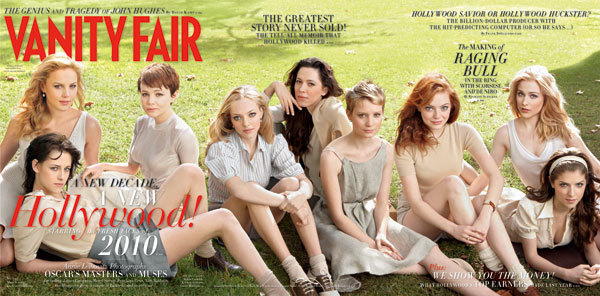
Has Vanity Fair Thrown us back 60 years?

16 years old, I went to prom. And like most other 16 and 17 year old girls, the big topic before the big day was what to wear. The months leading up to the night of adulthood was an ever so meticulous and thorough stalk of all dress shops, celebrity photos, and magazines for the most lovely, unique gown created. This was when I discovered Vanity Fair. I consumed its pages, imagining myself with Eddie Ramirez (indie school stud, of course) in this whimsical world created by this magazine (which I knew could NOT have been imaginary). I remember seeing the girls in this land of “perfect.” I was not them. I was me, a converse wearin, goof-ball, theater lovin, “college cool” wanna-be, that didn’t even meet a whisper of Vanity Fair’s standards.

As I think back to these Vanity Fair loving days I remember not finding too many similarities between these models and myself. I was always way too tall, too fat, too loud, and too not perfect… but the one thing that I did have in common with these tiny beauties was not on my mind.

I didn’t give it much thought then, but the glaring whiteness of the models makes a strong statement. In the new March 2010 Hollywood cover shows nine lovely, yet all ghostly white, women. Harry Allen, writer of Media Assassin, and hip-hop activist, explains that with all the talent that is accessible to only capture all white individuals, a “racial power statement” is being made.

The article by Allen can be found on his blog at: http://harryallen.info/?p=6737

Allen ever-so-poetically states:
“I wonder: While discussing Haiti over lunch, did any of these actors say, “Wow: This sure is one Caucazoid photo shoot”? Better yet, did anyone refuse to be part of something which so genteely hangs out the NO COLOREDS sign?”

He challenges the reader and the models to consider, “if you’re not part of a solution, you’re part of the problem.” Especially if your project “sends relations back sixty years.”

This ideology of white is beautiful (and only white) is not the point of view of the masses. Vanity Fair has most defiantly gone back 60 years, at least has not made any contribution to move forward as far as white supremacy in the media. A range of representation for the uniqueness of people is literally non existent this bubble of Vanity Fair. White supremacy has made its way through most television series, movies, political representations, news stories, etc. etc. etc. and at this point I would like to think we have changed or at least made progress from the depictions of perfect white families and assimilated black families. Progress that gives us a beautiful representation of the talent and ethnicities of our country, not a white washed horror as found in Vanity Fair.

After years and years of attempts to change the order with the civil rights movement and fight for all people of color, to have come to this... is a challenge to everyone. What can be different in our media? How can our conversations challenge this continue ideology that white is supreme?
Read More 1 Comment | Posted by The Unheard Voices
Newer Posts Older Posts Home

The Unheard Voices

  • Media
      Its what we do.
  • Media Blogs

    Blog Archive

    • ▼  2010 (34)
      • ►  April (9)
      • ►  March (9)
      • ▼  February (13)
        • Sex Sells, But Should It?
        • Is it getting hot in here?
        • Vodka
        • They will find a way.
        • Surviving Valentine's Day
        • Who Can Beat “American Idol”? No One.
        • Ellen DeGeneres
        • Yes, Our President is Black.
        • The New Age of Bullying.
        • Cool has been hunted.
        • What did I say?
        • Why Do We Need Apple's New iPad? Answer: We Don't!
        • Has Vanity Fair Thrown us back 60 years?
      • ►  January (3)

    Labels

    • advertisments (5)
    • Black (1)
    • Cell phones (1)
    • creation (1)
    • cyber-bullying (1)
    • earth (1)
    • Ellen DeGeneres (1)
    • evolution (1)
    • Facebook (1)
    • First Amendment (1)
    • freedom of speech (1)
    • front page (1)
    • gatekeeping (1)
    • global warming (1)
    • God (1)
    • green (1)
    • hegemony (1)
    • ideology (1)
    • Korea (1)
    • media (6)
    • media economics (1)
    • men (1)
    • movie (1)
    • newdow (1)
    • news media (1)
    • Nikon (1)
    • Obama (1)
    • objectification (1)
    • online advertising (2)
    • Paparazzi (1)
    • pledge of allegiance (1)
    • privacy (1)
    • pro-life (1)
    • racism (1)
    • remakes (1)
    • scientists (1)
    • sequels (1)
    • sexual (1)
    • star system (1)
    • super bowl (1)
    • the cool hunter (1)
    • Valentine's Day (2)
    • Vanity Fair (1)
    • White (2)
    • women (2)
  • Search


    • Home
    • Posts RSS
    • Comments RSS
    • Edit

    © Copyright The Unheard Voices. All rights reserved.
    Designed by FTL Wordpress Themes | Bloggerized by FalconHive.com

    This template is brought to you by : allblogtools.com Blogger Templates


    Back to Top